
Conformity of test results



In many technical, industrial, or scientific fields, testing is a central component of quality assurance. However, a measurement result alone does not indicate whether a product or component actually meets the specified requirements. This assessment is carried out as part of what is known as conformity assessment. In this article, we explain in easy-to-understand terms how a laboratory arrives at a conformity statement in accordance with ISO/IEC 17025:2018 and DAkkS requirements. CleanControlling describes the procedure for assessing the conformity of test results in document FB 35-74, which forms the basis for accreditation.
What does "conformity assessment" mean?
Essentially, conformity assessment answers a simple question:
"Does the measured result meet the required specification – yes or no?"
Specifications may include, for example:
- Standards
- Legal limits
- Technical standards
- Customer requirements
To do this, the laboratory compares the measured value with the specified limit or target value. The result of the evaluation is always clear:
✔ compliant (fulfilled) or
✘ non-compliant (not fulfilled)).
If only the measured values are required without evaluation:
In some cases, customers only want the measured values without any statement regarding conformity. This is useful, for example, in pure status quo analyses or development projects.
In such cases, the following applies:
- The laboratory only provides the measurement results.
- No limit value consideration, no decision rule.
- The interpretation is carried out by the client.
The test report clearly states that no conformity statement has been made.
What is a decision rule – and why is it important?
A decision rule specifies how the laboratory deals with measurement uncertainty in conformity assessment.
Why this is important:
Every measurement involves a certain degree of uncertainty. A decision rule defines a range within which the true value is highly likely to lie.
Example:
A measurement result is 98, the limit value is 100, and the measurement uncertainty is ± 5
→ The true value could therefore be between 93 and 103.
The decision rule answers the question:
"Is measurement uncertainty taken into account in conformity assessment or not?"
What decision-making rules are used?
Three possible approaches are described:
a) Requirements from standards or specifications
If there is a binding decision rule (e.g., in a standard), the laboratory applies only this rule.
b) Customer-specific rules according to ILAC G8
Customers can also define their own specifications in writing, e.g.:
- special safety distances
- individual risk assessments
- asymmetric decision-making areas
The laboratory then explicitly documents this in the test report.
c) Standard procedure: Simple acceptance
If no specifications exist, the laboratory uses simple acceptance:
Only the measured value counts—the measurement uncertainty is NOT taken into account for the evaluation.
This means:
- If the measured value is within the limit → compliant.
- If it is outside → non-compliant.
The measurement uncertainty is nevertheless determined and stored internally.
The seven valuation cases explained simply
The document FB 35-74 "Conformity of Test Results" from CleanControlling shows typical situations when dealing with limit values in the "simple acceptance" procedure. Figure 1 shows the seven cases (A to G) at a glance.
It is important to note that in the standard procedure, only the measured value counts, not the uncertainty. Therefore, cases C and D are still considered compliant, even though the uncertainty reaches the limit value.
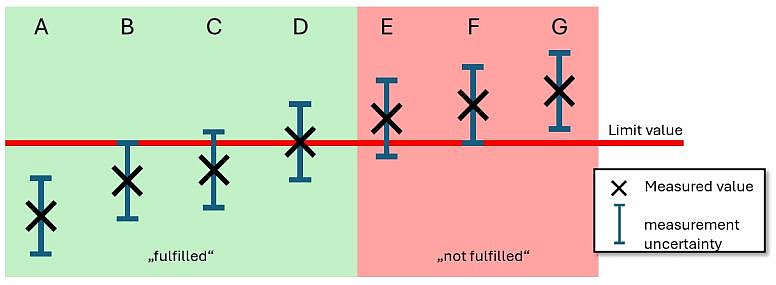
Source: FB 35-74, CleanControlling GmbH
Why transparency is so important
The documentation required by ISO/IEC 17025:2018 ensures that:
- the decision rule is clearly described,
- customers can understand how conformity was assessed,
- wrong decisions are minimized.
The transparent presentation makes it clear:
Conformity assessments are always systematic and rule-based — not subjective.
Conclusion
Conformity assessment is an essential step in correctly classifying measurement results and reliably meeting quality requirements.
This procedure ensures that:
- the procedure is clearly documented,
- decisions are traceable and reproducible,
- customer specifications can be taken into account,
- the handling of measurement uncertainty is clearly regulated.
This forms the basis for transparent, high-quality auditing services.
Newsletter registration