
Blank value in technical cleanliness



This article highlights the importance of the blank value in technical cleanliness. It compares the criteria of the current VDA 19.1 (2015) with the 2025 revision (yellow volume) and outlines practical measures for very clean components. Particular attention is paid to the evaluation of cleanliness values and measures in the event of non-compliance with the blank value, especially for very clean components.
Background
The blank value indicates the amount of particles that are introduced during the test but do not originate from the test object. A high blank value can significantly impair the validity of the cleanliness test.
VDA 19.1 defines limit values and test methods to ensure reliability. The cleanliness of the test environment must be adapted to the cleanliness level required or determined for the components. Therefore, the permissible blank value is derived from the cleanliness values of the component. The blank value must not be subtracted from the cleanliness value of the test object and is therefore part of the cleanliness value.
Blank value criteria in comparison
The blank value criterion specifies the maximum blank value that is permitted for the test result to be considered valid. The corresponding criteria are specified in VDA 19.1 (2015) as follows, in comparison to VDA 19.1 (2025, yellow volume).
| Criterion | VDA 19.1 (2015) | VDA 19.1 (2025, Yellow volume) |
| Gravimetric | ≤10 % of the residual weight | ≤10 % of the residue weight, supplemented by clear definitions in the event of non-compliance with the required blank value. |
| Number of particles | ≤10 % by size class | ≤10 % by size class, supplemented by clear definitions in the event of non-compliance with the required blank value. |
| Maximum size | No blank particles above specified size | No blank particles above specified size, additional documentation requirement |
Assessment in case of non-compliance
The revision of VDA 19.1 from 2025 (yellow volume) differentiates the assessment as follows:
- Blank value ≤ 10%, test result below limit value → specification complied with.
- Blank value > 10%, test result below limit value → specification complied with, but result not reliable and not valid for further interpretation.
- Blank value ≤ 10%, test result above limit value → specification not met.
- Blank value > 10%, test result above limit value → test invalid.
Measures for very clean components
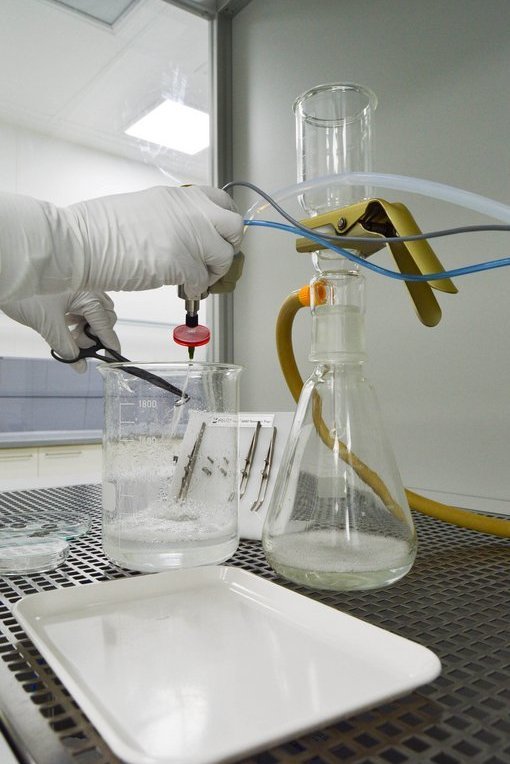
In the case of very clean components, the blank value criterion may not be technically feasible, as the inherent contamination of the testing equipment has a disproportionate impact. In such cases, VDA 19.1 recommends the following measures:
Technical measures
- Use higher-resolution scales in a controlled environment (e.g., air-conditioned room with constant humidity).
- Increase the test batch size: Extract several components at the same time to bring the particle load above the detection limit.
- Optimization of the extraction equipment: Minimization of wetted surfaces, use of materials with low particle emission, e.g., use of new laboratory glassware as extraction vessels.
- Particle extraction in a separate clean room area under additional laminar flow conditions (e.g., class 4 according to DIN ISO 14644-1).
Organizational measures
- Separation of test areas: e.g., separate rooms for drying, packaging, and extraction.
- Regular blank value tests to validate the cleanliness of the test equipment.
- Documentation of special cases: If the blank value criterion cannot be met, this must be noted in the test report and agreed upon with the customer.
Procedure-specific measures
- Use indirect extraction methods (e.g., ultrasound in beakers) to reduce environmental influences.
- Adjust the rinsing procedure: e.g., by rinsing critical areas separately.
- Only dispense with blank value testing if tested and validated extraction equipment is reused in a documented manner.
Conclusion
The blank value remains a decisive factor in the validity of cleanliness tests. The 2025 revision expands the methodology and offers practical solutions for very clean components. Particular caution is required if the blank value criterion is not met. Even if the limit value is not exceeded, the results may be unreliable and must not be used as a reliable basis for further interpretations.
Newsletter registration